IV: An Unlikely Client

Content warning: mentions of violence and murder

The old woman’s house was little more than a hut cobbled together from broken boards with a rusty tin chimney peeking out from the roof. A haze of cheap perfume, so thick Genevieve was certain she could almost see it, enveloped the entire premises; she pressed her face into her sleeve, breathing deeply of her own familiar scent, as she reached forward to knock on the door.

There was a clattering of footsteps and a hesitant pause before the door swung open. Standing behind it was a woman of only forty or fifty years, hardly the hag evoked by the Mayor’s tirade. Her hair was greying but still had thick streaks of chestnut throughout, and though her cheek and breast were puckered with burn scars and her forehead was lined with care, her eyes were as clear and bright as a summer’s afternoon.

 “I was told I could find a woman named Annette here?” Genevieve inquired. The woman nodded her head but did not relinquish her silence. “I am Hunter Gregoire, and this is my assistant Hunter Furst. The Mayor sent to the College for us. Might we have a word?”

The woman snorted and choked; it took Genevieve a moment to realize that this was the way that Annette laughed.

“Mayor Valis send for you?” Her voice whined and rasped all at once, like steel against stone, “He would never send for a Hunter.”

“And yet we are here,” Genevieve pointed out.

Another burst of sickening laughter. “Only because I sent for you.”

“You?” Genevieve asked, grasping for the confidence that had suddenly abandoned her, “Surely you couldn’t afford… the College answers to local government… why would you…”

“Because no one else was doing anything,” Annette replied, as if the answer were obvious even to a child. “And I happened to know someone in the College.”

Genevieve closed her eyes and inhaled, doing her best not to choke on the perfume-ladened air.

“Of course,” she said through a forced smile. The Mayor had welcomed them and acknowledged their presence as if he had invited them himself, but once they had arrived what other option was open to him? Any other response would have only drawn their suspicion. It irked Genevieve that she hadn’t realized this on her own.

“As for payment,” Annette continued, leaning against the bent door frame and crossing her arms, “I have something much more valuable than Francs.”

This drew Genevieve out of her self-absorbed reverie, curiosity hard at the reins. It wasn’t that the College was greedy, but they valued the coin to pursue their research and expand their reach. This woman either had very lofty connections, or a very valuable payment. Or both. Genevieve had an inkling as to Annette’s mysterious connection, but what this poor lady had to offer she hadn’t the faintest. “What is the payment?”

“To be delivered on completion of your mission,” she said matter-of-factly.

“Speaking of which,” Genevieve said, wrenching the conversation back into familiar territory, “We could use your insight.”

“Hahaha.”

Genevieve held her face taut, forcing herself not to cringe at the laugh.

“Never had anyone want to use me for that before,” Annette said, “Welcome change. I’d invite you in for tea but I don’t think you’d fit.”

It was true, the girth of Genevieve’s chair was much too wide for the narrow doorway. Rather than dwell on the matter, Annette plumped herself onto the floor and stretched her legs out into the chilly Autumn air.

“What do you need?”

“Names,” Genevieve said, “Suspicions even. We’d rather not miss anyone.”

“And what if I’m wrong? Got enough on my conscience without innocent lives weighing it down too.”

“We’ll know.” It was Darnell who spoke, and Annette’s attention snapped to him as if she were only now aware of his presence. Her gaze slid from his carefully combed hair down to the sharp angles of his jaw, down to his narrow shoulders, down, down, until she reached his well-polished shoes. She raised an eyebrow before continuing to ignore him once more.

“There’s usually a system of power,” Genevieve explained, as she had countless times before to men and women not so different from Annette. Outsiders – overlooked and ostracized – tended to see the workings of society that everyone else had blinded themselves to. She continued, “A hierarchy, with someone calling the shots and choosing who gets to join the ranks of the Beasts. Membership is often seen as a reward, but it can also be used as extortion. Anything you have to tell us about corruption, crime, abuse… it all helps.”

“Yeah,” Annette said, kicking at a loose rock with her shabby boot, “Still humans after all, aren’t they?”

“Some,” Genevieve said, causing Annette to look at her with something akin to contemplation, or even respect.

“Yes. I know them all, or close at least. They don’t worry about me; half the town thinks I’m one of them, or something worse… they can’t kill me or they won’t have anyone to pester anymore and then someone might find out who’s really been killing their children,” she sighed, “Old whore like me, I know everything that happens. That’s why they hate me. Single woman at my age, no children, to them I’m less natural than the Beasts.”

“Well, I suppose we have that in common,” Genevieve smiled, leaning down to meet the woman’s eyes, staring at the cracked end of her boot.

Annette smiled too. “It’s the Governor that’s leading them. Though that should come as no surprise to you.”

“No,” Genevieve answered, her smile fading with the last of the sunlight, “But I had to be sure.”

“Couple followers – I can give you their names. Mostly he just lets them run wild, unless some other young lad or lass catches his fancy, then he kills one to turn them. They’re afraid of him you see. Ever since his wife left and he killed his son for trying to usurp him… he’s gotten reckless. People turn a blind eye in case their children go missing, or worse, end up like Mayor Valis’ daughter.”

Genevieve nodded.

“So, you know about her already?” The older woman seemed mildly impressed.

“Like Darnell said, we have ways.” Genevieve thought back to what the Mayor had said once his daughter had been taken care of, “According to Mayor Valis, Governor L’Amie changed his daughter when he suspected that the town might turn against him. He would let her live, teach her to control her changes, only if the Mayor behaved accordingly.”

“Bastard,” Annette spit, “She’s not the only one either.”

“Names,” Genevieve said, “As many as you can give.”

Annette recited a list, providing any detail she thought might aid them in their endeavour.

Darnell recorded them while Genevieve considered the best way to approach the situation. If Annette’s information was accurate, the Governor’s underlings would be young and easily handled; since his son’s betrayal it was rare for him to trust anyone for too long. It was Governor L’Amie himself she worried about; he had undergone the change over two decades ago. Rumour suggested he had grown reckless, but even with Darnell at her side she feared he would be a considerable opponent.

It would be best to isolate him, if possible. And, as much as it betrayed her own sensibilities, it would be wisest to avoid having to fight him at all. Was that even possible, with a Beast of his age?

“Annette?” Genevieve asked suddenly, “Have you ever seen him?”

“Who? Marcus Dupont?” The woman answered, crinkling her already well-lined forehead in confusion.

“What?”

“The grocer. L’Amie brought him over some time last month, far as I can tell. Guaranteeing his food supply I suppose, given that no one wants to stay and cook…”

Genevieve realized that the conversation in her head did not align with the names and gossip her companions had been reviewing.

“No, no — Governor L’Amie. Have you ever seen him when he’s a Beast?”

Annette’s lips quivered, her eyes distant, as if reliving some blood-tinged memory. She shook her head. “No. No not him. I’ve seen others, though not up close. The woods are just behind my house and at night sometimes… well sometimes I see the silhouettes in the distance. Glimpses of fur and claws and horns through the trees.”

She wrapped her arms around herself, rubbing them as though just finally recalling the lateness of the season.

“Have to guess at the amount then,” Genevieve muttered.

“You have a plan,” Darnell stated.

Genevieve nodded. “It’s a risk though. If he’s smaller than I’m expecting, it’s possible I could kill him.”

“Isn’t that the point?” Annette asked.

Genevieve smiled at her, then looked to Darnell for his opinion.

“A few extra dead bodies might convince the College to approve that sabbatical you keep talking about,” he mused.

“Maybe I should up the dosage on purpose then,” she said, enjoying the rare smile with which she was rewarded. She hoped Darnell would not take it too hard when she resigned after the mission.

The sun was hardly over the horizon now, its light dancing through the scant foliage of the trees stretching away in the distance behind Annette’s shack. They should prepare, Genevieve thought. It wouldn’t be long before they were attacked, and the last thing she wanted was to drag Annette into the fray.

“Thank you for all of your assistance,” she said to Annette, whose mouth was still twisted in confusion over their brief exchange. “Stay indoors tonight, and don’t open to anyone.”

“As if I would,” the woman scoffed, pushing herself back to her feet. As she leaned over, Genevieve accidentally glimpsed an expanse of skin previously concealed beneath her bodice – a deep purple stain leaking out from the wrinkled scars above it.

“Would it be completely inappropriate of me to inquire about your scars?” She asked so suddenly that even Darnell looked at her in surprise.

To her relief, Annette smiled kindly, though the resignation in her voice weighed heavily on Genevieve’s conscience. “Used to be that the people of Ste Ygrette had a local Witch.”

“A Witch?” Darnell asked with incredulity. Like any good College member, he knew the difference between science and folklore.

“Just an outsider woman. Her father was a doctor and he taught her his trade when the schools wouldn’t have her. She travelled about, teaching other girls like herself and helping women have their babies. Settled here by herself,” Annette squinted at Genevieve, “You know this story.”

Genevieve nodded; she knew it by heart, and countless others like it.

“When she settled here, people were happy at first. Until there came a sickness. People grew ill and then they died, and of course who else was there to blame? Clearly she was a Witch – see the way she lives alone with no want of a husband? See how she spreads lies to the women and tries to corrupt them? See how her skin is of a different shade? Her very existence condemned her.”

“What happened?” Darnell asked, and Genevieve watched the curious twinkle in his eye with a wave of nostalgia.

“They hurt her. Burned her house. Ostracized her. Starved her. She lived out here, in this hut, scarred, hungry, and alone.” Annette stroked the warped doorframe, smiling faintly as if to an old friend. “Eventually people started going missing. Beggars and prostitutes at first. Easy to turn a blind eye to. Then others. Victims torn to shreds — poor and wealthy alike. The people looked to the Mayor at that time for help, and he looked to Governor L’Amie. The Governor sent two men to deal with the obvious source of the bloodshed…”

There was a pause, and Genevieve watched Darnell’s face – the deepening furrow of his brow, the click of his jaw as he bit down in frustration or perhaps despair.

“All anyone found afterward was a shack dripping with blood, the poor woman’s arm, and scraps of flesh and cloth. No one knew what had happened, but they did learn one thing: the killings didn’t stop. There’d be days, weeks, even months where it seemed as though the terror had ceased, but it would always continue again. Word started to come from other towns and villages about the Beasts and the College that Hunted them. But help never came for Sainte Ygrette.”

“They called it a curse,” she continued, “The Witch had cursed them for falsely accusing her, and so the most logical thing was to do it all over again. They found a woman, an old prostitute with no family and an ugly birthmark and said it was her. Here, see the mark of blood upon her chest, they cried, and they burned it from her flesh.”

“And yet the killings continue.” Genevieve shook her head.

Annette smirked, “It seems we are cursed.”

“So’s the whole damned world,” Genevieve said, turning to leave.

“Good luck, Hunter,” Annette called out, her laugh grating against Genevieve’s bones as it chased her over the uneven path back to the main thoroughfare.

<— III: The Inconvenience of Hunger

V: Transformations —>

Return to The Beast of Ste Ygrette

***Author’s Note***

Audio will be up in a day or two. There’s been a few… toddler-sized bumps in the road with regards to my recording schedule. Episodes will release as usual, but audio may occasionally lag a little behind. Thanks for checking out the series, and I hope you’re enjoying it so far! Don’t forget to leave a like or comment to let me know what you think. ❤
III: The Inconvenience of Hunger

Content warning: violence against a child, animal death

***

The first face the babe awoke to was not human, but canine. It startled her, the fuzzy muzzle and liquid brown eyes hovering so close over her own, and she cried out heartily.

There was no smell of mother here, but there was a warmth not unlike hers which wrapped around the baby and lifted her into the air. A new face peered down. It was twisted – corner of the mouth raised here, funny pink slashes across its dark cheek there, and an eye not quite opened – but it was human. This face smiled and a voice cooed so softly that the curiosity swirling within the child did not dissolve into fear.

Something wet and warm brushed her cheek, something that made her stomach clench in hunger. She sucked on this soft thing, craving the liquid in which it was soaked, though it wasn’t quite as sweet as Mother’s milk. Occasionally the woman who held her stole the cloth away, evoking tears and screams, but it returned quickly, soaked once more in warmth and sweetness.

The dog, though she had no word for it yet, frightened her for many days. She had never seen a creature like it, and it snuffled loudly with its wet cold nose against her head. Cold was something the baby was coming to know well; she felt it often now, and it seemed that parts of her body were made of nothing else. Eventually she came to know the dog as a source of warmth and eventually safety and comfort. In the baby’s mind these were the beginnings of love.

But she was also beginning to learn hunger. She’d felt the desperate need for food since the moment she was born, but as her fragile body tried to grow, she found milk-soaked rags inadequate. It was then that she learned true hunger – a hunger that was both fear and pain, a hunger that made her sleepy and weak, and a hunger that made her try to eat things that made the woman shout out and wipe her tongue.

Maman Tee, as the woman came to be called, began to act strangely, casting worrying glances at the child while she rested in her nest of rags against the dog’s warm fur. She cried often, except on those odd days when a visitor would come and exchange shiny circles of metal for a bag of odd smelling plants or a bottle of cloudy liquid — all of which the child had tried to consume at some time or another. After the stranger left, Maman Tee would disappear and come back with food. Real food that filled the child’s belly and tasted good against her tongue. Those were the merry days – when Maman Tee would laugh and sing with the dog barking and running circles around her feet. The child would hold tight to the warm neck of her saviour and fall asleep being swung about in her arms.

Then one day men came to the door. They banged and shouted. Maman Tee left and when she returned her face was different — crestfallen and tear-stained yes, but swollen too and the wrong colour. She held the child and wept. After that there were no visitors for a long time, and no singing or laughter either. And worst of all, the hunger returned until the child could no longer remember that she had ever felt anything else.

Finally, there came an evening when, after the child was laid to rest, Maman Tee sat over her for a long while inspecting the hollows of her cheeks and thinking on the hollow in her tiny belly. Still on the verge of sleep, eyes closed and body still, the child felt the blanket lifted from her chest and up and over her face. It tickled, but after a moment the pleasant sensation turned to panic. There was no air, only a gentle pressure over her face which she flailed against with the little strength her arms could muster.

Just as she began to drift into blackness, the blanket was torn away and Maman Tee lifted her to her breast. They clung to each other, weeping hot tears.

“I’m sorry. Oh God, I’m so sorry.”

Maman Tee kissed her all over.

“I’m so sorry, my baby, my love.”

The child didn’t understand her words, but she accepted her love and drifted off to sleep with her head resting against the woman’s shoulder.

When she woke the next day, the dog was gone. She was old enough to understand its disappearance by then, comprehending that objects and people and dogs should not disappear without a reason. In her own way she asked after him, but Maman Tee had no answer that would satisfy the child.

“She’s taking care of you, my love,” she would say, but the babe heard only her sadness and saw only her tears.

That night they had food, and with it the remembrance of times of joy and song, but to the child’s disappointment the songs did not come. Maman Tee did not eat with her, and nor did she sing or smile.

***

Genevieve emerged from the Mayor’s house with Darnell at her side. The pistol was concealed once more, and the only evidence of what had transpired was splattered across Darnell’s white shirtfront.

“Well that did not go as smoothly as I might have liked,” she said, pushing herself along the street in the direction of Ste. Ygrette’s only inn.

“I apologize for my slow response, Mademoiselle,” Darnell answered, hanging his head.

“No, not at all, you did what was required. It’s just a pity. I quite like dogs.” There were curious eyes upon her, she could feel them staring down from windows and out from alleys and doorways. No, this was certainly not the best start she could have hoped for. Not that this was ever going to be an easy job. “We need to get you changed, before we start a bloody panic.”

The room provided to them was cramped with bulky wooden furniture, and Genevieve groaned as she tried to manoeuvre her way to where their luggage was stored. Darnell undressed, replacing his shirt behind her.

“They could have afforded us a nicer room,” she complained, giving up and waiting for Darnell to finish, “Given that we’re here to save them and whatnot.”

“I’m not sure they can afford us anything else,” Darnell replied, fastening the last of his buttons, “The Mayor seemed to only be squeaking by, and that doesn’t say much for the state of the town’s finances.”

“True,” she admitted, managing to turn her chair to face him only by bumping into the towering armoire behind her half a dozen times, “Fetch me a new pair of gloves, will you? These ones smell like gun powder now.”

He reached past her into one of her cases and passed her a pair of silk gloves, identical to the pair she was removing.

“Thank you,” she told him, and seeing the tension between his brow she added, “And honestly, you did well. After this many years I wish you wouldn’t doubt yourself so much. You should take a sabbatical after this assignment. I most certainly plan on taking one.”

His smile was subtle, but rare enough for Genevieve to judge it as genuine.

“Alright… now off to that old lady’s house. What was her name again?”

“Annette,” Darnell answered, retrieving his jacket and aiding Genevieve back into hers.

“Yes. That one. I have a feeling she’ll have a great deal of insight for us.”

<— II: An Ill-Timed Meeting

Part IV: An Unlikely Client —>

Return to The Beast of Ste Ygrette

I: An Ominous Welcome

Content warning: blood, violence against a child, human death

Sainte Ygrette was burning when Genevieve arrived. As her coach approached, slowing at the sight of ash and smoke, she felt as though she were entering the town’s own private midnight. Greasy black plumes choked off what little sunlight the autumn clouds permitted, and the gaslights were already doused, their lines evacuated before they could cause greater disaster. The only light came from the embers strewn across scorched rooftops and the flames that still licked the shingles of a giant manor house at the end of the road.

The coach stopped several blocks from the source of the chaos and Darnell dismounted to aid in Genevieve’s descent. From the rear of the carriage, he hefted a solid wooden chair and lowered it gently to the cobbled road. He rolled it along on two oversized wheels until he reached her door and then lifted her down onto its upholstered seat. Genevieve straightened the bulk of her lilac-coloured silk dress, gently brushing away the wrinkles as a few townsmen rushed by, seemingly oblivious to her presence.

“Should I aid them, Mademoiselle?”

Genevieve watched with cold curiosity as half a dozen men passed buckets and three or four others ran off to find more. The blackened building loomed over them as if complicit in the fiery chaos, a creature threatening to devour them. Tearing her eyes from this spectacle, Genevieve noticed a handful of people clinging to doorways and peeking from the windows of buildings far enough away from the blaze to create an illusion of safety. She gripped the hefty rims of her chair’s wheels and propelled herself forward, approaching a stern-faced woman with three trembling children clutching at her legs.

“Excuse me,” she called to them. The children’s eyes flew to the ornately carved wood of her seat and the wheels beneath her black gloves (white ones would always get ruined, as much as she preferred them). The mother’s eyes did the opposite, flying this way and that, any direction to try to avoid the contraption on which Genevieve was seated.

Well, Genevieve always did much prefer speaking with children anyway.

She directed her speech to the eldest, a girl of perhaps seven. “Do you know if anyone is inside the building there? The big one with all the flames?”

The girl blinked. Clearly she was not used to being the one addressed by adults. She shook her head. “Only the governor lives there now. He’s the one who told everyone about the fire.”

“What about the staff?” Genevieve asked, but then rephrased as the girl’s mouth twisted in confusion, “The people who work there? Housemaids and cooks and such.”

“There aren’t any.” It was the mother who answered this time, and Genevieve raised her chin to address her properly.

“None?” she asked, tilting her head at this bizarre tidbit.

“I go in a couple times a week to help with the laundry and tidying, but seeing as most of the house is empty ain’t no point keeping it all dusted. He buys his meals around town, or maybe makes some himself.” The mother hesitated, her gaze returning to the ash and flame, “Not many who’ll go in there at all these days.”

“Oh?” Genevieve asked, a hungry grin splitting her face, “Why’s that?”

“Cursed, isn’t it?” she answered with a shiver.

“So it would seem.”

Wrangling the bulk of her chair, Genevieve made to return to where Darnell was waiting beside the coach, but the mother made a noise as if to call her back.

“Yes?”

“Are you… I mean, did they send you? Are you here to help us?”

The eldest girl’s eyes went wide, flying from her mother and back to Genevieve. They burned with a hope and wonder that made Genevieve straighten her posture, and smirk as she answered:

“Ah, yes,  I am Hunter Gregoire. That gentleman across the way is my assistant, Hunter Furst.” A slight bow of the head, but not so low that she couldn’t watch the woman’s mouth droop a little in disappointed surprise.

“You? But surely you…”

“Are your best hope,” Genevieve interrupted, “And I will be expecting your full cooperation. Once the flames are out, of course.”

This time she turned away without hesitation and returned to where Darnell stood rigidly straight (as was his habit), watching the thick smoke rising from the now-diminished flames.

“We wait,” she told him, “They’ll have it out soon enough. Let the beast burn.”

Darnell nodded, and they watched and waited together.

***

Windows glinted like eyes, reflecting the light of the half-moon in those brief moments when she winked down through the clouds: the only witnesses to the gruesome scene below. The night was cold for early June, but the mother’s blood kept the babe warm, drenched as she was in it. She cried out, in pain and confusion: Mother’s smell is near. Mother’s warmth is near. Where is mother?

Still the eyes stared, the hulking mass of the building looming, a frigid stillness permeating the night.

The babe cried until she slept through the pain and fear. Her primal brain knew little, except how to cry for help and how to surrender when it didn’t come. She continued to sleep even when – against all odds – help did come and carried her away. Away from her dead mother. Away from the watchful eyes of the manor house. Away from the murderers concealed within.

***

*** Author’s Note***

Hey everyone, thank you so much for reading the first episode of The Beast of Ste Ygrette! The series will be eight parts in length and run bi-weekly until the end of October. Think of it as a Hallowe’en special, if you will. Don’t forget to like and comment if you enjoyed the episode, and follow the blog (at the bottom of the page) or check me out on Instagram for updates to the series. Thanks again for your support <3.

Part II: An Ill-Timed Meeting —>

Return to The Beast of Ste Ygrette

Why I only have panic attacks after the kids are in bed.

I dive so deeply into days
flooded with motherhood
eyes closed
breath held
that by the time I surface
the dusky light burns my eyes
silence pierces my ears
and my atrophied lungs stutter
starved for oxygen
I tell them to pace themselves
but they are ravenous
in out in out in out
until I am drowning in rest

@amnotpoetry

New web fiction series coming this October!

Hey. It’s been a while. I have a little something for you…

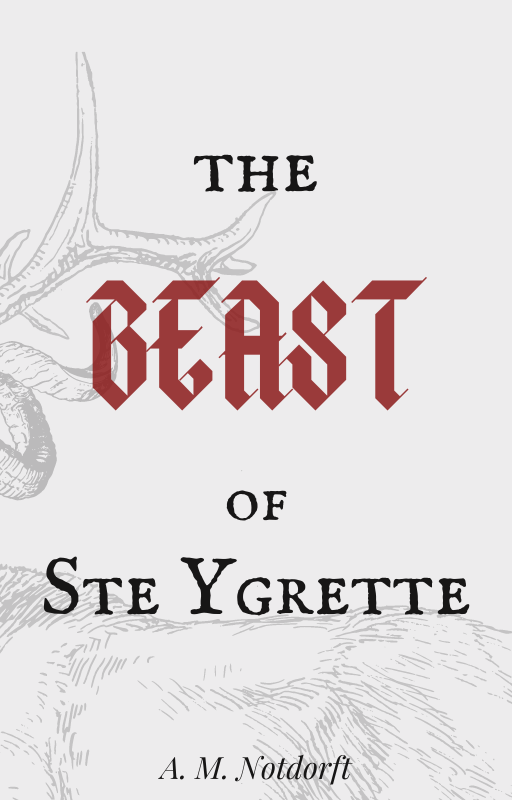
When the town of Ste. Ygrette is overrun by Beasts, the College sends Hunter Gregoire and her assistant to solve the problem. What they find is a town cursed with more than the inhuman creatures that stalk it, and a decades old question that begs to be answered.

Yes! I know it’s long overdue but I’ll be releasing a new series just in time for Hallowe’en. It won’t be a full-length series like 53 Ganymede, but it will span the length of October (likely with a bi-weekly release schedule).

This is a massive departure from the relaxing fantasy of Ganymede, and is more in the vein of paranormal Victorian horror/action. If you’re into werewolves (think Bloodborne, not Twilight), gritty 19th century settings, and badass, wheelchair-using, pistol-slinging female protagonists… join me for part 1 on Wednesday, October 6th.

I’ll see you then!

Creative Process

My creative process
is a bomb defusal
in a crowded room
where the people
keep wandering by
to peek over my shoulder.

My mother cringes
as I touch the red wire,
so I drop the pliers
and pick up a screwdriver.
Left, left, left —
until the screw wiggles
and I hear my old professors
sigh in unison
— right, right, right.

I pore through the pages
of a tear-stained manual
but can’t concentrate
amidst the impatient chatter
of an Instagram following.
I press a button on a whim
and brace myself.
A gasp. A cry.
But nothing happens.

For a moment
I think this might be luck,
but as the voices die
I hear it in the silence:
tick, tick, tick.
The trickle of time running out.

I check the manual.
There is a whisper.
I whip the book to the floor.
A muffled clatter.
A tut and a groan.
I pick it up again
and get back to work.

Tomorrow

My every day is balanced
on the knife point
of panic.
Tonight I lost my voice,
my words refusing to file
neatly in line,
rushing so quickly
that they caught in my throat,
my breath trampled beneath them.
My husband found me
on the floor
drowning in a scream
so vast that it left me
silent.

I am not okay.

Life is a trap:
just when I think
I’ve got the knack
of shrinking myself
a little bit smaller,
the walls close in
a little bit tighter.
And maybe the daylight
will make things look
a little bit brighter,
a little bit wider,
but I am not ready
to surrender today
to get to tomorrow.

So I guess this is me
tearing up my white flag,
claiming victory
with the words that sought
to suffocate me:
I am not okay.
I am tired.
I am angry.
I am grieving.
I am afraid of tomorrow.

But tomorrow will come.
I think I am ready now.

Because the universe is not obligated to tell me of your passing

One moment you will be here
and the next you will be gone.
There is a line somewhere,
as fine as spider’s silk,
that divides a world with you
from a world without.
I am afraid of stepping over
that near-invisible crack
without even noticing,
until I look back
and find it has grown
into a canyon.

Photo by MARIOLA GROBELSKA on Unsplash

I want to talk about anime, not what I do all day.

I am the shadow of my motherhood.
I am what comes after the stroller,
so that you already know
the shape of me
before you’ve really looked.

I am cast with the waking of the sun,
and warp around demands
much bigger than the mouths
that make them,
stretching and shrinking as needed.

So please excuse my melodramatics
and the volume of my voice
when I talk about politics, science, poetry,
video games, or anything but my kids.
I’m just trying to cast the shape of myself.

Photo by Johny Goerend on Unsplash

I am here.

So I’ve been on hiatus for… a while.

I’m okay.

I wasn’t okay.

But I’m mostly okay now.

I’ve had depression and anxiety for a very long time, but there’s always been a good reason to push it aside. To tell myself that I’ll be alright as long as I keep moving. That I don’t need help. That it’s “normal.” That I can handle it.

I’m sure I’m not the only person who has had those beliefs shattered in the past year. My existential crises suddenly found themselves with some very real material, and my coping mechanisms — social events, going out by myself, getting someone to watch the kids — went flying out the window.

To be honest, it didn’t feel like what I was experiencing was even related to the pandemic, and in some ways it wasn’t — my mental health wasn’t great to begin with after all — but whether I acknowledged the pressure bearing down on me or not, it was still there. In the way I couldn’t take my children to the park or to the grocery store. In the way I hadn’t been away from them for more than half an hour in several months. In the masks I saw hanging from rear-view mirrors as I walked down the street. In the way that walking those streets had become a sick strategy game — weaving back and forth or meandering blocks out of the way so that I didn’t have to go within two metres of anyone else.

I felt it in my core even if I didn’t acknowledge it. I stopped doing anything. I stopped being anything. I wanted to just stop altogether.

So I got help. For the first time. And just… thank God. Why the hell didn’t I do this sooner?

Please, whether it’s been a lifelong thing or it’s a new thing… if you feel empty, overly anxious, meaningless, like your entire self is about to implode… tell someone. Preferably your doctor. Look for community resources if you don’t have access to paid therapy and can’t afford it. Online therapy. Just, ask for help. I promise you deserve it. (For the record I signed up for a government-funded online therapy clinic and used a free CBT app called Woebot while I was waitlisted.)

And if you are in crisis, please call a crisis support line or stop by your emergency department. Your life matters and I swear you are strong enough to get through this. You just haven’t been given the tools yet. You’ve been climbing a mountain with your bare hands and you’ve still gotten this far. Imagine where you’d get if someone gave you some climbing equipment (and taught you how to use it).

Anyway. Therapy and mental health supports aside (but seriously, access them if you think you need them), I thought it was about time for an update.

Even before the pandemic, I was really struggling with my creativity. Not so much a writer’s block, just a lack of passion for… well… anything. Writing included. This of course, caused extra anxiety as I thought to myself… will I ever be creative again? Will I ever feel again? Despite the way we romanticize mental illness, that poetic melancholy or artistic moodiness, it is NOT conducive to creativity. I am a much better (and definitely productive) creator when I am mentally well.

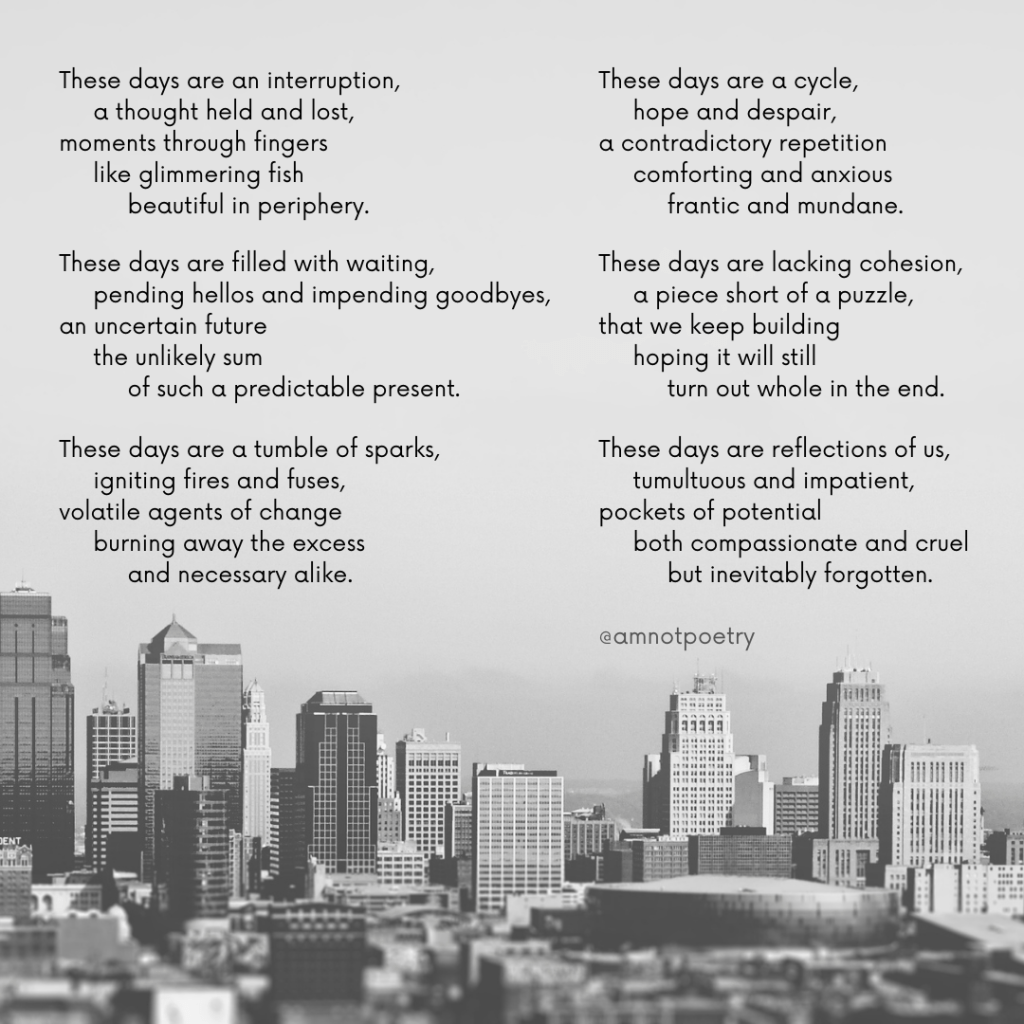
While I was recovering, and within the pressures of parenting during a pandemic, the only thing I’ve consistently found time for has been poetry. It’s short, I can write and edit it on my phone, and it’s cathartic as hell. I’ve actually started a poetry Instagram with the tag @amnotpoetry. You can see the feed over there —>
I’ll do some poetry posts to update any new ones to the site and file them under the Poetry section up there. ^

I also quit twitter for now, because who needs that negativity?

An example of the kind of stuff I’m doing over on insta

As for what comes next… well, I’m trying to take it easy for now in terms of setting goals, but I AM working on a few stories again. I’d also still like to work on finishing the voice recordings of Ganymede, but ultimately that comes down to finding a period of time and a space where I can consistently create a quiet enough environment. Worst case, it’ll happen as restrictions from the pandemic ease off and I can book a space. The focus right now is on creation, and eventually the debate of going the webfiction route again, or trying for traditional publishing. But that is a ways off (though I’d love to hear what you think!)

I’ll try to do more consistent blog posts. I have one mostly written already about media that’s kept me sane and helped me deal with my depression over the past year. Books, podcasts, video games, etc. So stay tuned.

Anyway, I’m back. It’ll take some time for me to fall into a regular habit of posting, but for now, I am just so ecstatic to be creating again. I hope everyone out there is doing alright and taking care of themselves as best they can. It’s okay to take a break, sometimes just getting through the day is enough. We’ve got this, one day at a time.